Area Related to Circles - Test Papers
CBSE Test Paper 01
Chapter 12 Area Related to Circle
- The part of the circular region enclosed by a chord and the corresponding arc of a circle is called (1)
- a segment
- a diameter
- a radius
- a sector
- If a line meets the circle in two distinct points, it is called (1)
- a chord
- a radius
- secant
- a tangent
- Area of a sector of angle p (in degrees) of a circle with radius R is (1)
- If ‘r’ is the radius of a circle, then it's circumference is given by (1)
- None of these
- The perimeter of a protractor is (1)
If circumference of a circle is 44 cm, then what will be the area of the circle? (1)
Find the area of circle that can be inscribed in a square of side 10 cm. (1)
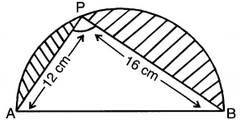
In the given figure, AB is the diameter where AP = 12 cm and PB = 16 cm. Taking the value of as 3, find the perimeter of the shaded region. (1)
If the perimeter of a semi-circular protactor is 36 cm, then find its diameter. (1)
What is the perimeter of a square which circumscribes a circle of radius a cm? (1)
On a square cardboard sheet of area 784 cm2, four circular plates of maximum size are placed such that each circular plate touches the other two plates and each side of the square sheet is tangent to circular plates. Find the area of the square sheet not covered by the circular plates. (2)
The circumference of a circle is 22 cm. Find the area of its quadrant. (2)
A sector of a circle of radius 4 cm contains an angle of 30°. Find the area of the sector. (2)
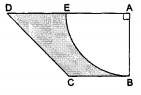
In the given figure, ABCD is a trapezium of area 24.5 cm. If AD II BC, = 90°, AD = 10 cm, BC = 4 cm and ABE is quadrant of a circle then find the area of the shaded region. (3)
- The given figure depicts a racing track whose left and right ends are semi-circular. The difference between the two inner parallel line segments is 60m and they are each 106m long. If the track is 10m wide, find:
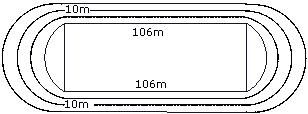
- The distance around the track along its inner edge,
- The area of the track. (3)
A circular pond is 17.5 m in diameter. It is surrounded by a 2 m wide path. Find the cost of constructing the path at the rate of Rs 25 per m2. (3)
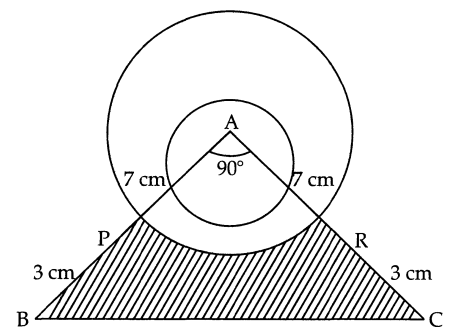
A momento is made as shown in the figure. Its base PBCR is silver plated from the front side. Find the area which is silver plated. (3)
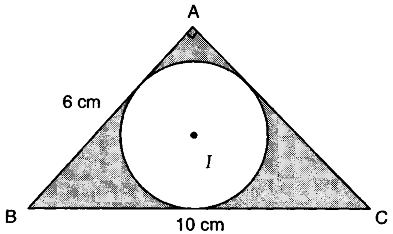
In Figure ABC is a right-angled triangle at A. Find the area of the shaded region, if AB = 6 cm, BC = 10 cm and I is the centre of incircle of (4)
- A chord of a circle of radius 10cm subtends a right angle at the center. Find the area of the corresponding: (Use = 3.14)
- minor sector
- major sector
- minor segment
- major segment (4)
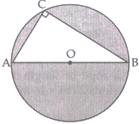
In the given figure, AB is diameter of circle, AC = 6 and BC = 8 cm. Find the area of the shaded region. ( = 3.14). (4)
CBSE Test Paper 01
Chapter 12 Area Related to Circle
Solution
- a segment
Explanation: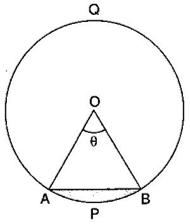
The part of the circular region enclosed by a chord and the corresponding arc of a circle is called a segment.
- a segment
- secant
Explanation: A secant line, also simply called a secant, is a line meet two points in a circle.
- secant
-
Explanation: Area of the sector of angle p of a circle with radius R
-
-
Explanation: If the radius of a circle is given, the circumference or perimeter can be calculated using the formula below:-
Circumference =
-
-
Explanation: Let radius of the protractor be Perimeter of protractor = Perimeter of semicircle + Diameter of semicirclePerimeter of protractor =
-
Circumference of a circle = 44 cm
Radius of the circle =
Area of the circle =
= 154 cm2.
So, Area of the circle is 154 cm2.Side of square = 10 cm
Side of square = diameter of square = 10 cm
Radius of the circle =
Area of the circle =
In APB
AB2 = AP2 + PB2
(From Pythagoras theorem)
Radius of circle = =10 cm.
Perimeter of shaded region
cm.Perimeter of a semi-circular protactor = Perimeter of a semi-circle = (circumference of circle) + diameter = (circumference of circle) + 2 radius =
[ Given, perimeter of semi-cicular protactor = 36]
Hence, diameter of semi-circular protactor = 2r = 2(7) = 14cmWhen a square circumscribes a circle, the radius of the circle is half the length of the square.
Therefore, if the radius of the circumscribed circle is a, the diameter will be 2a. It is this diameter that is equal to the length of the square.
Therefore, the length of the square is 2a cm.
Then area of a square =4 length
= 4 2a cm
= 8a cmLet the radius of each circular plate be r cm. Then,
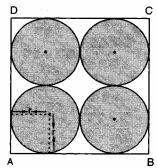
Length of each side of the square sheet = 4r cm.
Area of the square cardboard sheet = (4r 4r) cm2 = 16 r2 cm2
But, the area of the cardboard sheet is given to be 784 cm2
16r2 = 784 r2 = 49
r = 7
Area of one circular plate = = 154 cm
Area of four circular plates = 4 154 cm2 = 616 cm2
Uncovered area of the square sheet = (784 - 616) cm2 = 168 cm2Suppose be the radius of a circle
Circumference of a circle
Area of the quadrant of a circleRadius of cirlce = 4cm
Area of sectorArea of the trapezium ABCD
(sum of parallel sides) distance between them
= 7 AB
Radius of a quadrant ABE = 3.5 cm
Area of a quadrant ABE
= 9.625 cm2
Now, Area of the shaded region
= Area of the trapezium ABCD - Area of a quadrant ABE
= 24.5 - 9.625
= 14.875 cm2- The distance around the track along the inner edge = 106 + 106 + ( 30 + 30)
= 212 + 60 = 212 + = - The area of the track = 106 80 - 106 60 + 2 [402 - 302]
= 106 20 + (70) (10)
= 2120 + 700 = 2120 + 2200 = 4320 m2
- The distance around the track along the inner edge = 106 + 106 + ( 30 + 30)
Radius of a pond
Area of a pond
Radius of a circle including path = 8.75 + 2 = 10.75 m
According to question,
Area of the path = Area of a circle including path - Area of a pond
= 122.5 sq.m
Cost of constructing the path = = Rs.3062.50
Base = 7 + 3 = 10cm and height = 7 + 3 =10 cm
From the given figure
Area of right-angled
cm2
Area of quadrant APR of the circle of radius 7 cm
Area of quadrant
Area of base PBCR = Area of ABC - Area of quadrant APR
= = 11.5 cm2.
So, Area of shaded portion is 11.5 cm2.Applying Pythagoras theorem in , we obtain
BC2 = AB2 + AC2
AC2 = BC2 - AB2
AC2 = 100 - 36 = 64
AC = 8 cm
Area of = 24 cm2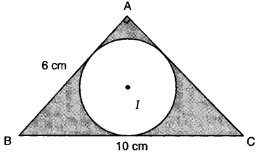
Let r cm be the radius of the incircle, (circle inscribed in We observe that: Area of = Area of + Area of + Area of
24 = 12r
r = 2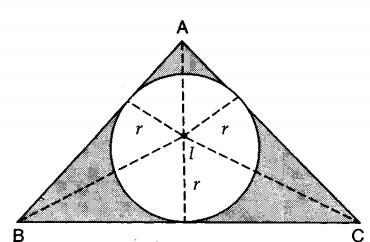
Let A be the area of the shaded region. Then,
A = Area of - Area of the incircle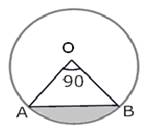
- Area of minor sector =
= 78.50 = 78.5 cm2 - Area of major sector = Area of circle - Area of minor sector
= (10)2 - (10)2 = 3.14 (100) - (3.14) (100)
= 314 - 78.50 = 235.5 cm2 - We know that area of minor segment
= Area of minor sector OAB - Area of ΔOAB
Area of sector =
= (3.14) (100) - 50 = 25(3.14) - 50 = 78.50 - 50 = 28.5 cm2 - Area of major segment = Area of the circle - Area of minor segment
= (10)2 - 28.5
= 100(3.14) - 28.5
= 314 - 28. 5 = 285.5 cm2
- Area of minor sector =
Identify the figure as a circle, and a right-angled triangle (and semicircle, segment also) since AOB is diameter and angle in semicircle is 90o.
Therefore, C = 90o
In right-angled ABC,
b = base = BC = 8 cm
a = altitude = AC = 6 cm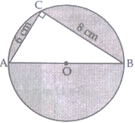
Therefore,by Pythagoras theorem in right ABC,
AB2 = BC2 + AC2
= 82 + 62 = 64 + 36
AB2 = 100 cm
AB = 10 cm
Therefore, r = = 5 cm
Therefore, Area of shaded region = Area of circle – Area of right ABC
= πr2 – Base Alt.
= 3.14 5 5 – 8 6
= 3.14 25 – 8 3 = (78.50 – 24) cm2 = 54.50 cm2
Therefore, Area of shaded region = 54.50 cm2