Arithmetic Progressions - Test Papers
CBSE Test Paper 01
Chapter 05 Arithmetic Progression
- In an AP, if a = 4, n = 7 and = 4, then the value of ‘d’ is (1)
- 0
- 1
- 3
- 2
- The next two terms of the AP : k, 2k + 1, 3k + 2, 4k + 3, ………… are (1)
- 5k + 4 and 6k + 5
- 4k + 4 and 4k + 5
- 5k + 5 and 6k + 6
- 5k and 6k
- The common difference of the A.P. can be (1)
- only negative
- only zero
- positive, negative or zero
- only positive
- The 7th term from the end of the A.P. – 11, – 8, – 5, ……., 49 is (1)
- 28
- 31
- -11
- -8
- The common difference of the A.P whose is (1)
- 3
- 1
- -3
- 2
If 5 times the 5th term of an AP is equal to 10 times the 10th term, show that its 15th term is zero. (1)
Write the first term a and the common difference d of A.P. -1.1, - 3.1, -5.1, - 7.1,... (1)
For what value of n are the nth term of the following two AP's are same 13, 19, 25, .... and 69, 68, 67 .... (1)
Find k, if the given value of x is the kth term of the given AP , 11, , 22, ..., x = 550. (1)
Find the 6th term from the end of the A.P. 17,14,11,..., - 40 (1)
How many terms of the AP 17,15,13,11,... must be added to get the sum 72? (2)
Find n. Given a = first term = -18.9, d = common difference = 2.5, an = the nth term = 3.6, n = ? (2)
Find the number of terms in each of the following APs. 18, , 13, ….., – 47. (2)
The first and the last terms of an AP are 5 and 45 respectively. If the sum of all its terms is 400, find the common difference and the number of terms. (3)
The 14th term of an A.P. is twice its 8th term. If the 6th term is -8, then find the sum of its first 20 terms. (3)
Find the 6th term from end of the AP 17, 14, 11, …, –40. (3)
The houses of a row in a colony are numbered consecutively from 1 to 49. Show that there is a value of x such that the sum of the numbers of the houses preceding the house numbered x is equal to the sum of the numbers of the houses following it. Find the value of x. (3)
The sum of first n terms of an A.P. is 3n2 + 4n. Find the 25th term of this A.P. (4)
If sum of first 6 terms of an A.P. is 36 and that of the first 16 terms is 256, find the sum of the first 10 terms. (4)
The sum of the third and the seventh terms of an AP is 6 and their product is 8. Find the sum of the first sixteen terms of the AP. (4)
CBSE Test Paper 01
Chapter 05 Arithmetic Progression
Answers
- 0
Explanation: Given: a = 4, n = 7 and = 4, then
4 - 4 = 6d
- 0
- 5k + 4 and 6k + 5
Explanation: Given:
Here
Therefore, the next two terms are
and
- 5k + 4 and 6k + 5
- positive, negative or zero
Explanation: The common difference of the A.P. can be positive, e.g. 1, 2, 3, 4 ..... d is +ve and series is increasing negative e.g 4, 3, 2, 1 ...... d is - ve and series is decreasing
or zero also and the AP becomes constant e.g 4, 4, 4, 4 .......
- positive, negative or zero
- 31
Explanation: Reversing the given A.P., we have
Here, and
=
- 31
- – 3
Explanation: Given:
Putting , we get
Common difference
- – 3
Let 1st term = a and common difference = d.
a5 = a + 4d, a10 = a + 9d
According to the question, 5 a5 = 10 a10 5(a + 4d) = 10(a + 9d) 5a + 20d = 10a + 90d a = -14d
Now, a15 = a + 14d a15 = -14d + 14d = 0.-1.1, - 3.1, -5.1, - 7.1,...
First term (a) = -1.1
We know that common difference is difference between any two consecutive terms of an A.P.
So, common difference(d) = (-3.1) - (-1.1)
= -3.1 + 1.1
= -2nth term of 13, 19, 25, ............ = nth term of 69, 68, 67, .........
13 + (n - 1) 6 = 69 + (n - 1) (-1)
13 + 6n - 6 = 69 - n + 1
n + 6n = 70 - 7
7n = 63
n = 9
Therefore, n = 9a = , d = a2 - a1 = 11 - = and x = 550
A.T.Q., ak = x
) = 550
+ k - = 550
k =A.P. is 17,14,11,..., - 40
We have,
l = Last term = -40 , a = 17 and, d = Common difference= 14 - 17 = - 3
6th term from the end = l - (n -1)d
= l - (6-1) d
= -40 - 5 (-3 )
= -40 + 15
= -25
So, 6th term of given A.P. is -25.Given A.P. is 17, 15, 13, 11........
Here, 1st term (a) = 17 and common difference (d ) = (15 - 17) = -2
Let the sum of n terms be 72. Then,
Sn = 72
{2a + (n - 1)d} = 72
n{2 × 17 + (n - 1)(-2)} = 144
n(36 - 2n)=144
2n2- 36n + 144 = 0
n2 - 18n + 72 = 0
n2 - 12n - 6n + 72 = 0
n(n - 12) - 6(n - 12) = 0
(n - 12)(n - 6) = 0
n = 6 or n = 12.
sum of first 6 terms = sum of first 12 terms = 72.
This means that the sum of all terms from 7th to 12th is zero.an = a + (n - 1)d
3.6 = - 18.9 + (n - 1) (2.5)
3.6 + 18.9 = (n - 1) (2.5)
22.5 = (n - 1) (2.5)
n - 1 = 9
n = 10
Here, a = 18
an = -47
Let the number of terms be n.
Then,
an = -47
a + (n - 1)d = -47
n - 1 = 26
n = 26 + 1
n = 27
Hence, the number of terms of the given AP is 27.Let the given AP contains n terms.
First term, a = 5
Last term, l = 45
Sn = 400
[a + l] = 400
[5 + 45] = 400
n 50 = 800
n = 16
Thus, the given AP contains 16 terms.
Let d be the common difference of the given AP.
then,
T16 = 45
a + 15d = 45
5 + 15d = 45
15d = 40
d ==.
Therefore, common difference of the given AP is .Let first term be a and common difference be d.
Here, a14 = 2a8
a + 13d = 2(a + 7d)
a + 13d = 2a + 14d
a = - d...(i)
a6 = - 8
a + 5d = -8 ... (ii)
Putting the value of a from (i) in (ii), we get
-d + 5d = -8
4d = -8
d = -2
Put d = -2 in (i)
a = -(-2)
a = 2
So ,a = 2, d = - 2
= 10(4 - 38)
= 10 (-34)
= - 340. Which is the required sum of first 20 terms.The given AP is 17, 14, 11, ......., – 40
Here, a = 17
d = 14 - 17 = -3
l = -40
Let there be n terms between in the given AP
Then, nth term = -40
a + (n - 1)d = -40
17 + (n - 1) (-3) = -40
(n - 1) (-3) = -40 - 17
(n - 1) (-3) = -57
n - 1= 19
n = 19 + 1
n = 20
Hence, there are 20 terms in the given AP.
Now, 6th term from the end
= (20 - 6 + 1)th term from the beginning
= 15th term from the beginning
= a + (15 - 1)d
= 17 + 14 (-3)
= 17 - 42
= - 25
Hence, the 6th term from the end of the given AP is -25.According to the question, we have to find the value of x.
We are given an AP, namely 1,2,3,..., (x -1), x, (x +1),..., 49
such that 1 + 2 + 3 +... + (x -1) = (x +1) + (x + 2) +... + 49.
Thus, we have Sx-1 = S49- Sx ... (i)
Using the formula, Sn = (a + l) in (i), we have,
2x2 = 2450 x2 = 1225 x = = 35
Hence, x = 35.According to the question,
Sum of n terms of the A.P. Sn = 3n2 + 4n
S1 = 3 12 + 4 1 = 7 = t1 ....(i)
S2 = 3 22 + 4 2 = 20 = t1 + t2 ....(i)
S3 = 3 32 + 4 3 = 39 = t1 + t2 + t3 .... (iii)
From (i), (ii), (iii)
t1 = 7, t2 = 13, t3 = 19
Common difference, d = 13 - 7 = 6
25th of the term of this A.P., t = 7 + (25 - 1)6
= 7 + 144 = 151
The 25th term of the A.P. is 151.Consider the A.P. whose first term and common difference are ‘a’ and ‘d’ respectively.
If sum of first 6 terms of an A.P. is 36.
S6 = 36
[2a + (6 – 1)d] = 36
3[2a + 5d] = 36
2a + 5d =
2a + 5d = 12 …(i)
If sum of first 16 terms is 256,
So, S16 = 256
[2a + (16 – 1)d] = 256
8[2a + 15d] = 256
2a + 15d =
2a + 15d = 32 …(ii)
Subtracting (i) from (ii), we get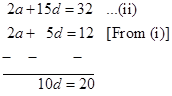
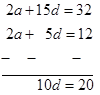
d = 2
Now, 2a + 5d = 12 [From (i)]
2a + 5(2) = 12
2a + 10 = 12
2a = 12 – 10
a =
a = 1
Hence, a = 1 and d = 2
So, S10 = [2a + (10 – 1)d]
= 5[2(1) + 9(2)]
= 5[2 + 18]
= 5[20]
= 100
S10 = 100
Hence, the sum of first 10 terms is 100.Let the first term and the common difference of the AP be a and d respectively.
According to the question,
Third term + seventh term = 6
[a + (3 - 1)d] + [a + (7 - 1)d] = 6 = a + (n - 1)d
(a + 2d) + (a + 6d) = 6 2a + 8d = 6
a + 4d = 3 ..... (1)
Dividing throughout by 2 &
(third term) (seventh term) = 8
(a + 2d) (a + 6d) = 8
(a + 4d - 2d) (a + 4d + 2d) = 8
(3 - 2d) (3 + 2d) = 8
9 - 4d2 = 8
Case I, when
Then from (1),
a + 2 = 3 a = 3 - 2 a = 1
Sum of first sixteen terms of the AP = S16
= 8[2a + 15d]
Case II. When
Then from (1),
a - 2 = 3 a = 3 + 2 a = 5
Sum of first sixteen terms of the AP = S16