Circles - Test Papers
CBSE Test Paper 01
Chapter 10 Circles
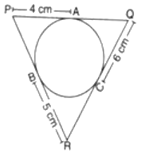
- The perimeter of in the given figure is (1)
- 15 cm
- 60 cm
- 45 cm
- 30 cm.
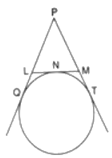
- If PQ = 28 cm, then the perimeter of PLM is (1)
- 48 cm
- 56 cm
- 42 cm
- 28 cm
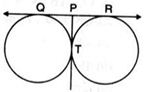
- In the given figure if QP = 4.5 cm, then the measure of QR is equal to (1)
- 15 cm
- 9 cm
- 18 cm
- 13.5 cm
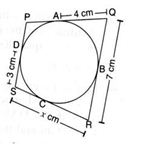
- In the given figure, if AQ = 4 cm, QR = 7 cm, DS = 3 cm, then x is equal to (1)
- 6 cm
- 10 cm
- 11 cm
- 8 cm
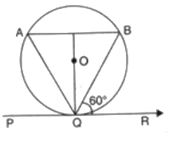
- If PQR is a tangent to a circle at Q whose centre is O, AB is a chord parallel to PR and , then AQB is equal to (1)
- 60°
- 30°
- 90°
- 45°
How many common tangents can be drawn to two circles touching internally? (1)
How many tangents can a circle have? (1)
A quadrilateral ABCD is drawn to circumscribe a circle. If AB = 12 cm, BC = 15 cm and CD = 14 cm, find AD. (1)
How many tangents, parallel to a secant can a circle have? (1)
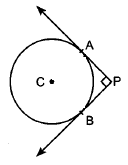
In figure, PA and PB are two tangents drawn from an external point P to a circle with centre C and radius 4 cm. If PA PB, find the length of each tangent. (1)
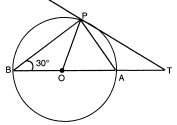
In the given figure,line BOA is a diameter of a circle and the tangent at a point P meets BA when produced at T. If PBO = 30o what is the measure of PTA? (2)
Two concentric circles are of radii 7 cm and r cm respectively where r > 7. A chord of the larger circle of the length 48 cm, touches the smaller circle. Find the value of r. (2)
In the adjoining figure, a right angled , circumscribes a circle of radius r. If AB and BC are of lengths 8 cm and 6 cm respectively, then find the value of r. (2)
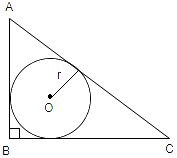
PQR is a right angled triangle right angled at Q. PQ = 5 cm, QR = 12 cm. A circle with centre O is inscribed in PQR, touching its all sides. Find the radius of the circle. (3)
ABC is a right-angled triangle, right angled at A. A circle is inscribed in it. The lengths of two sides containing the right angle are 24 cm and 10 cm. Find the radius of the incircle. (3)
Two concentric circles are of radii 5 cm and 3 cm, find the length of the chord of the larger circle which touches the smaller circle. (3)
The common tangents AB and CD to two circles with centres O and O' intersect at E between their centres. Prove that the points O, E and O' are collinear. (3)
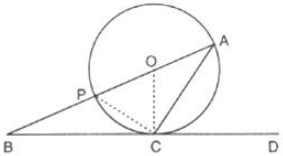
In fig O is the centre of the circle and BCD is tangent to it at C. Prove that . (4)
If a, b, c are the sides of a right triangle where c is the hypotenuse, prove that at the radius r of the circle which touches the sides of the triangle is given by r = (4)
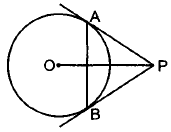
In figure, PA and PB are two tangents drawn from an external point P to a circle with centre O. Prove that OP is the right bisector of line segment AB. (4)
CBSE Test Paper 01
Chapter 10 Circles
Solution
- 30 cm.
Explanation Since Tangents from an external point to a circle are equal.PA = PB = 4 cm,
BR = CR = 5 cm
CQ = AQ = 6 cm
Perimeter of PQR = PQ + QR + RP
= PA + AQ + QC + CR + BR + PB
= 4 + 6 + 6 + 5 + 5 + 4 = 30 cm
- 30 cm.
- 56 cm
Explanation: We know that, PQ = (Perimeter of PLM)
28 = (Perimeter of PLM)
(Perimeter of PLM) = 28 2 = 56 cm
- 56 cm
- 9 cm
Explanation: Here QP = PT = 4.5 cm [Tangents to a circle from an external point P]
Also PT = PR = 4.5 cm [Tangents to a circle from an external point P]
QR = QP + PQ= 4.5 + 4.5 = 9 cm
- 9 cm
- 6 cm
Explanation: Here AQ = 4 cm
QB = AQ = 4 cm [Tangents from an external point]
BR = 7 - 4 = 3 cm
BR = CR = 3 cm [Tangents from an external point]
Also SD = SC = 3 cm [Tangents from an external point]
Therefore, x = CS + CR = 3 + 3 = 6 units
- 6 cm
- 60°
Explanation: Since AB PR and BQ is intersecting them.
[Alternate angles]
And [Alternate segment theorem]
Now, in triangle AQB,
AQB + 60° + 60° = 180°
AQB = 60
- 60°
One common tangent can be drawn to two circles touching internally
Figure: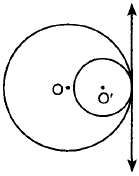
- A circle can have infinitely many tangents since there are infinitely many points on the circumference of the circle and at each point of it, it has a unique tangent.
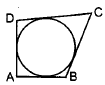
Now,
A circle can have 2 tangents parallel to a secant.
Diagram: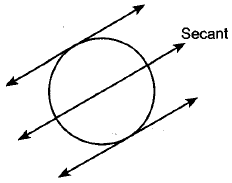
PA and PB are two tangents drawn from an external point P to a circle.
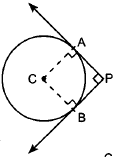
CA AP
CB BP
PA PB
BPAC is a square.
( Angle subtended by an arc is twice angle subtended by same arc at any other point on the circle)
(Radius and Tangent are perpendicular to each other)
In
( ASP)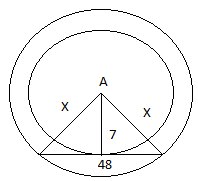
Let us take r = x
Now using Pythagoras theorem
(x)2 = 242 + 72
(x)2 = 576 + 49
(x)2 = 625
Therefore, x = 25 cm.
r = 25 cm.Let D, E and F are points where the in-circle touches the sides AB, BC and CA respectively. Join OA, OB and OC.
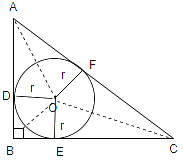
In [By Pythagoras theorem]
=
= 100
[taking positive square root , as length cannot be negative]
Now,
and
The value of r is 2 cm.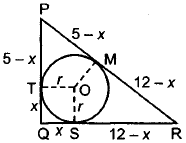
Let QS = x; SR = 12 - x
PT = 5 - x, PM = PT
PM = 5 - x
Also SR = MR MR = 12 - x
Also PQ2 + QR2 = PR2
PR = 13 PM + MR = 13
2x = 4 x = 2
Also OSQT is a square
Given,
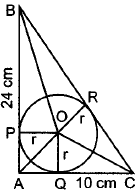
In right-angled ABC
Let r be the radius of the incircle
OP AB, OQ AC and OR BC
OP = OQ = OR [Incentre of a triangle is equidistant from its sides]
ar(ABC) = ar(AOB) + ar(BOC) + ar(AOC)
120 = r[24+ 10 + 26]
120 = 30r r = 4 cmPQ is the chord of the larger circle which touches the smaller circle at the point L. Since PQ is tangent at the point L to the smaller circle with centre O.
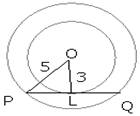
OL PQ
PQ is a chord of the bigger circle and OL PQ
OL bisects PQ
PQ = 2 PL
In OPL,
Chord PQ = 2PL =8 cm
Length of chord PQ = 8 cmConstruction: Join OA and OC.
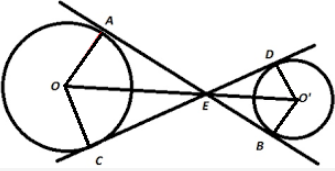
....(vertically opposite angles)
In OAE and OCE,
OA = OC ...(Radii of the same circle)
OE = OE ...(Common side)
....(each is 90°)
....(RHS congruence criterion)
....(cpct)
Similarly, for the circle with centre O',
Now,
Hence, all the fours angles are equal and bisected by OE and O'E.
So, O, E and O' are collinear.
(tangent and radii are to one another at the point of contact)
In OCA,
OC = OA (radii of circle)
Hence, (angles opposite to equal sides are equal)
Also,
Hence,
Hence proved.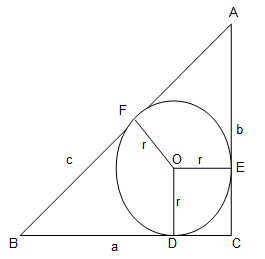
The circle touches the sides BC, CA, AB of the right triangle ABC at D, E and F respectively. Let BC = a, CA = b and AB = c
Now, AF = AE and BD = BF
⇒ AF = AE = AC - CE and BF = BD = BC - CD
⇒ AF = b - r and BF = a - r ( OEDC is a square)
⇒ AF + BF = ( b - r ) + (a - r)
⇒ AB = a + b - 2r
⇒ c = a + b - 2 r
⇒ r =Given, PA and PB are two tangents.
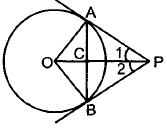
Construction: Join
In PAO and [Radii]
[Common]
and [Tangents from P]
PAO = PBO (SSS)
1 = 2
In APC and BPC, 1 = 2 [Proved]
APC BPC [SAS]
AC = BC
and ACP = BCP
Also, ACP + BCP = 180°[by linear pair axiom]
ACP + 90° = 180°
ACP = 90°
OP is right bisector of AB.