Constructions - Test Papers
CBSE Test Paper 01
Chapter 11 Construction
- To divide a line segment PQ in the ration 7 : 3 internally, first a ray PX is drawn so that is an acute angle and then at equal distances, points are marked on the ray PX such that the minimum number of these points is : (1)
- 7
- 3
- 4
- 10
- Which theorem criterion we are using in giving the justification of the division of a line segment by usual method? (1)
- Basic Proportionality theorem
- SSS criterion
- Pythagoras theorem
- Area theorem
- In the given figure, AA1 = A1A2 = A2A3 = A3C
IF B1A1 || CB, then A1 divides AC in the ratio (1)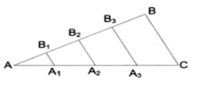
- 4 : 1
- 1 : 3
- 1/4
- 1 : 2
- To divide a line segment AB internally in the ratio 4 : 7, first a ray AX is drawn so that is an acute angle and then at equal distances, points are marked on ray AX such that the minimum number of these points are: (1)
- 9
- 11
- 10
- 12
- A pair of tangents of 6cm long can be constructed from a point P to a circle of radius cm situated at a distance of ………... from the centre (1)
- 10 cm
- 8cm
- 7.5cm
- 2cm
- The construction of a triangle, similar and larger to a given triangle as per given scale factor is possible only when (1)
- Independent of scale factor
- To divide a line segment AB in the ration 4 : 7, a ray AX is drawn first such that is an acute angle and then points …. are located at equal distances on the ray AX and the point B is joined to (1)
- To draw a pair of tangents to a circle which are at right angles to each other, it is required to draw tangents at end points of the two radii of the circle, which are inclined at an angle of (1)
- 45o
- 120o
- 60o
- 90o
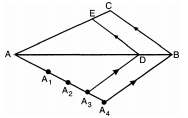
- In figure, ADE is constructed similar to ABC, write down the scale factor. (1)
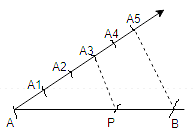
- Find the ratio of division of the line segment AB by the point P from A in the following figure. (1)
- To divide the line segment AB in the ratio 2: 3, a ray AX is drawn such that BAX is acute, AX is then marked at equal intervals. Find a minimum number of these marks. (1)
- Draw a circle of radius 2.5 cm. Take a point P on it. Construct a tangent at the point P. (2)
- Construct a triangle with sides 5 cm, 6 cm and 7 cm and then another triangle whose sides are of the corresponding sides of the first triangle. (2)
- Draw two tangents to a circle of radius 3.5 cm from a point P at a distance of 6.2 cm from its centre. (2)
- Draw a right angled ΔABC in which BC = 12 cm, AB = 5 cm, and ∠B = 90°. Construct a triangle similar to it and of scale factor . Is the new triangle also a right triangle? (2)
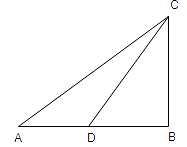
- In the given figure , if CD = 17 m , BD = 8 m and AD = 4 cm, find the value of AC. (2)
- Construct a in which AB = 6.5cm and BC = 5.5 cm. Also, construct a similar to whose each side is times the corresponding sides of the . (3)
- Construct a tangent to a circle of radius 4cm from a point on the concentric circle of radius 6cm. (3)
- Draw a right triangle in which the sides are of lengths 4 cm and 3 cm. Then construct another triangle whose sides are times the corresponding sides of the given triangle. (3)
- Draw a line segment of length 7.6 cm and divide it in the ratio 5 : 8. Measure the two parts. (3)
CBSE Test Paper 01
Chapter 11 Construction
Solution
- 10
Explanation: According to the question, the minimum number of those points which are to be marked should be (Numerator + Denominator) i.e., 7 + 3 = 10
- 10
- Basic Proportionality theorem
Explanation: The intercept theorem, also known as Thales' theorem or basic proportionality theorem, is an important theorem in elementary geometry about the ratios of various line segments that are created if two intersecting lines are intercepted by a pair of parallels. It is equivalent to the theorem about ratios in similar triangles.
- Basic Proportionality theorem
- 1/4
Explanation: In the figure, AA1 = A1 A2 = A2A3 = A3C
= 1/4
- 1/4
- 11
Explanation: According to the question, the minimum number of those points which are to be marked should be (Numerator + Denominator) i.e. 4 + 7 = 11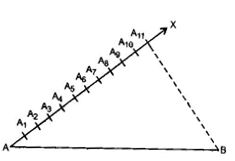
- 11
- 10cm
Explanation: As the tangent makes right angled triangle with the distance from centre and the radius at the point of touching it makes .now the distance from centre is hypotenous
- 10cm
- m > n
Explanation: The construction of a triangle, similar and larger to a given triangle as per given scale factor, m:n is possible only when.
Because We have to construct a similar and larger triangle so that side of this triangle should be larger to the given triangle.
- m > n
- A11
Explanation: To divide a line segment AB in the ratio m:n (when m > n), a ray AX is drawn such that BAX is an acute angle and then points A1, A2, A3...Am,…..An…. are located at equal distances on the ray AX and then the point B is joined to
- A11
- 90o
Explanation: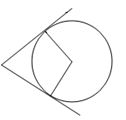
According to the question, the tangents are inclined at an angle of 180o - 90o = 90o
- 90o
ADE is constructed similar to ABC, we have to write down the scale factor.
Scale factor =
AP : PB = 3 : 2The line segment AB in the ratio 2: 3.
So, minimum number of marks = 2 + 3 = 5- STEPS OF CONSTRUCTION
- Draw a circle of radius 2.5 cm taking a point O as its centre.
- Mark a point P on this circle.
- Join OP.
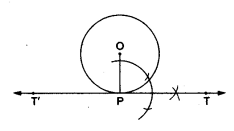
- Construct OPT = 90°
- Produce TP to T'.
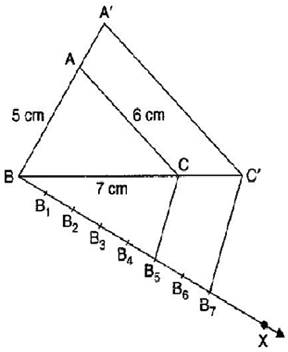
To construct: To construct a triangle of sides 5 cm, 6 cm and 7 cm and then a triangle similar to it whose sides are of the corresponding sides of the first triangle.
Steps of construction:- Draw a triangle ABC of sides 5 cm, 6 cm and 7 cm.
- From any ray BX, making an acute angle with BC on the side opposite to the vertex A.
- Locate 7 points B1, B2, B3, B4, B5, B6 and B7 on BX such that BB1 = B1 B2 = B2 B3 = B3 B4 = B4 B5 = B5 B6 = B6 B7.
- Join B5 C and draw a line through the point B7, draw a line parallel to B5 C intersecting BC at the point C'.
- Draw a line through C' parallel to the line CA to intersect BA at A'.
Then, A'BC' is the required triangle.
Justification :
[By construction]
[AA similarity]
[By Basic Proportionality Theorem]
[By construction]
[AA similarity]
But [By construction]
Therefore,
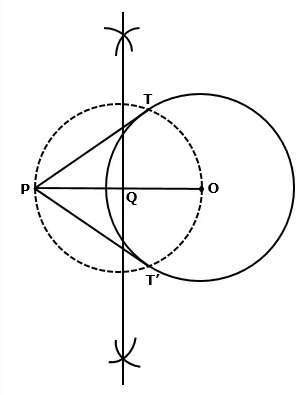
Steps of construction:- Take a point O on the plane of the paper and draw a circle of radius 3.5 cm.
- Mark a point P at a distance of 6.2 cm from the centre O and join OP.
- Draw a right bisector of OP, intersecting OP at Q.
- Taking Q as centre and OQ = PQ as radius, draw a circle to intersect the given circle at T and T'.
- Join PT and PT' to get the required tangents.
Here, scale factor or ratio factor is < 1, so triangle to be constructed will be smaller than given ΔABC.
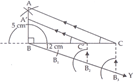
Step of construction:- Draw BC = 12 cm.
- Draw ∠CBA = 90° with scale and compass.
- Cut BA = 5 cm such that ∠ABC = 90°.
- Join AC. ΔABC is the given triangle.
- Draw an acute ∠CBY such that A and Y are in opposite direction with respect to BC.
- Divide BY in 3 equal segments by marking arc at same distance at B1, B2, and B3.
- Join B3C.
- Draw B2C’ || B2C by making equal alternate angles at B2 and B3.
- From point C’, draw C’ A' || CA by making equal alternate angles at C and C’.
ΔA’BC’ is the required triangle of scale factor . This triangle is also a right triangle.
Using Pythagoras theorem in ,
m.
Now, to find AC, apply pythagoras theorem in
m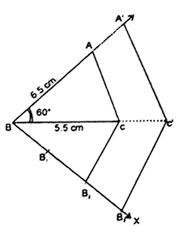
Steps of construction:- Construct a ABC in which AB = 6.5 cm, B = 60°, BC = 5.5 cm.
- At B draw an acute angle CBX below base BC.
- Along BX, mark off points BB1 = B1B2 = B2B3.
- Join B2 to C.
- From B3 draw B3C' || B2C at C.
- At C' draw C'A' || CA intersecting AB at C.
- is required triangle similar to
Steps of construction:
- Draw two circles with radius OA = 4cm and OP = 6cm with O as centre.
- Draw perpendicular bisector of OP at M. Taking M as centre and OM as radius draw another circle intersecting the smaller circle at A and B touching the bigger circle at P.
- Join PA and PB.
- PA and PB are the required tangents.
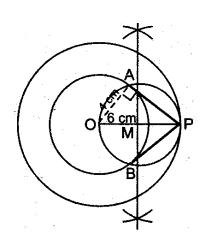
Verification:
In right angle triangle OAP,
OA2 + AP2 = OP2 ---[Pythagoras theorem]
42 + (AP)2 = 62
(AP)2 = 36 – 16 = 20
AP = = 2= 2 (2.236) = 4.472 = 4.5 cm
By measurement, PA = PB = 4.5 cm
Required:
To draw a right triangle in which the sides(other than hypotenuse) are of lengths 4 cm and 3 cm and then construct another whose sides are times the corresponding sides of the given triangle.
Steps of construction:- Draw a right triangle ABC in which the sides (other than hypotenuse) are of lengths 4 cm and 3 cm
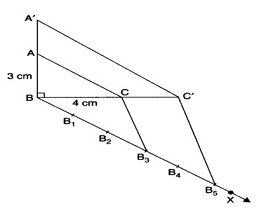
- Draw any ray BX making an ACute angle with BC on the side opposite to the vertex A.
- Locate 5 points B1.B2,B3,B4 and B5 on BX such that BB1=B21B2=B3B4=B4B5.
- Join B3 to C draw a line through B5 parallel to B3C, intersecting the extended line segment BC at C'.
- Draw a line through C' parallel to CA intersecting the extended line segment BA at A'.
Then, A'B'C is the required triangle.
Justification:
C'A||CA [By Construction]
ABC A'B'C' [AA similarity criterion]
[ corresponding sides of two similar triangle are proportional]
B6C'||B3C [By constryction]
BB5C' BB3C [AA similarity criterion]
[By basic proportionality theorem]
But [By construction]
- Draw a right triangle ABC in which the sides (other than hypotenuse) are of lengths 4 cm and 3 cm
Given: A line segment of length 7.6 cm.
Required: To divide it in the ratio 5 : 8 and to measure the two parts.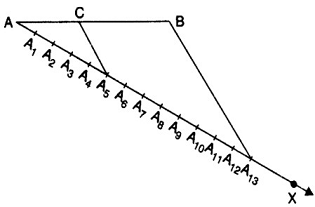
Steps of construction :- From any ray AX, making an acute angle with AB.
- Locate 13 (= 5 + 8) points A1, A2, A3,..... and A13 on AX such that
AA1 = A1A2 = A2A3 = A3A4 = A4A5 = A5A6 = A6A7 = A7A8 = A8A9 = A9A10 = A10A11 = A11A12 = A12A13 - Join BA13
- Through the point A5, draw a line parallel to A13B intersecting AB at the point C.
Then, AC : CB = 5 : 8
On measurement, AC = 3.1 cm, CB = 4.5 cm.
Justification :
A5C || A13B [ By Construction]
[By the Basic proportionality theorem]
But, [ By Construction[
Therefore,
This shows that C divides AB in the ratio 5 : 8.