Introduction to Trigonometry - Solutions
CBSE Class–10 Mathematics
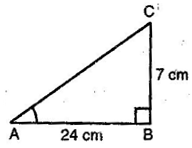
1. In  ABC, right angled at B, AB = 24 cm, BC = 7 cm. Determine:
(i) 
(ii) 
Ans. Let us draw a right angled triangle ABC, right angled at B.
Using Pythagoras theorem,
Let AC = 24k and BC = 7k
Using Pythagoras theorem,

=  = 576 + 49 = 625
 AC = 25 cm
(i) ,
(ii) ,
2. In adjoining figure, find  :
:
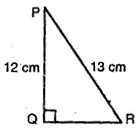
Ans. In triangle PQR, Using Pythagoras theorem,

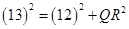
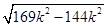
 = 169 – 144 = 25
QR = 5 cm

 = =
= =  =
=  = 0
= 0
3. If  calculate
  and
and 
Ans. Given: A triangle ABC in which  B =
B = 
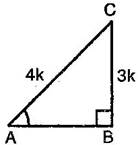
Let BC =  and AC =
Then, Using Pythagoras theorem,
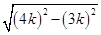
AB = 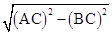 =
= 
=  =
= 
4. Given  find
find  and
and 
Ans. Given: A triangle ABC in which B =


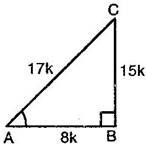
Let AB =  and BC =
Then using Pythagoras theorem,
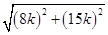
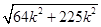
AC = 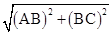
= 
= 
=  =
= 
5. Given  calculate all other trigonometric ratios.
Ans. Consider a triangle ABC in which A =  and B =
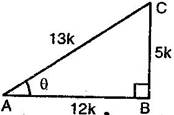
Let AB =  and BC =
Then, using Pythagoras theorem,
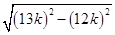
BC = 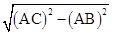
= 
= 
=  =
=
6. If And B are acute angles such that  then show that A = B.
Ans. In right triangle ABC,
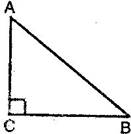
 and
and 
But  [Given]

AC = BC
A = B
[Angles opposite to equal sides are equal]
7. If  evaluate:
(i) 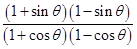
(ii) 
Ans. Consider a triangle ABC in which A = and B =
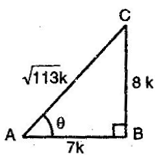
Let AB =  and BC =
Then, using Pythagoras theorem,
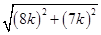
AC = 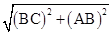
= 
= 
=  =
= 
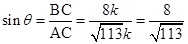
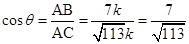
(i) = 
=  =
=  =
= 
(ii) 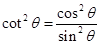 =
=  =
=
8. If  check whether
 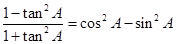 or not.
Ans. Consider a triangle ABC in which B = .
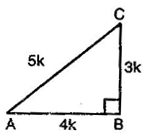
And 

Let AB = and BC = 
Then, using Pythagoras theorem,
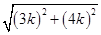
AC =
= 
= 
= =
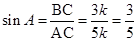
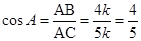
And 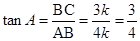
Now, L.H.S.  =
= 
=  =
= 
R.H.S.  =
= 
=  =
=
 L.H.S. = R.H.S.
=
9. In ABC right angles at B, if  find value of:
(i) 
(ii) 
Ans. Consider a triangle ABC in which B = .
Let BC =  and AB =
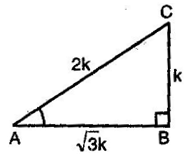
Then, using Pythagoras theorem,
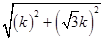
AC =
= 
=  =
=  =
= 
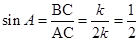
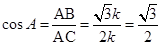
For C, Base = BC, Perpendicular = AB and Hypotenuse = AC
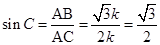
(i) = 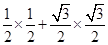
=  = 1
= 1
(ii) = 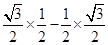
= 
10. In PQR, right angled at Q, PR + QR = 25 cm and PQ = 5 cm. Determine the values of  and
and 
Ans. In PQR, right angled at Q.
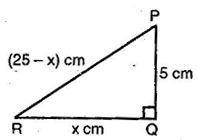
PR + QR = 25 cm and PQ = 5 cm
Let QR =  cm, then PR =
  cm
cm
Using Pythagoras theorem,

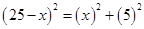



RQ = 12 cm and RP = 25 – 12 = 13 cm
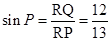
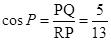
And 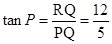
11. State whether the following are true or false. Justify your answer.
(i) The value of  is always less than 1.
(ii)  for some value of angle A.
(iii) is the abbreviation used for the cosecant of angle A.
(iv)  is the product of
  and A.
(v)  for some angle
Ans. (i) False because sides of a right triangle may have any length, so may have any value.
(ii) True as  is always greater than 1.
(iii) False as is the abbreviation of cosine A.
(iv) False as is not the product of ‘cot’ and A. ‘cot’ is separated from A has no meaning.
(v) False as  cannot be > 1.