Surface Areas and Volumes - Test Papers
CBSE Test Paper 01
Chapter 13 Surface Areas and Volumes
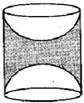
A cylindrical cone sharpened on both the edges is the combination of (1)
- a frustum of a cone and a cylinder
- two cones and a cylinder
- a cone and a hemisphere
- a hemisphere and a cylinder
A shoe box is a 15cm long, 10cm broad and 9cm high. The volume of the box is (1)
- 1350
- 1500
- 1200
- 1000
A plumbline is combination of (1)
- a hemisphere and a cone
- a hemisphere and a cylinder
- a cone and a cylinder
- a sphere and a cylinder
A solid is in the shape of a cone standing on a hemisphere with both their radii being equal to 1cm and the height of the cone is equal to its radius. The volume of the solid is (1)
The number of spherical balls each of radius 1cm can be made from a solid sphere of lead of radius 6cm is (1)
- 576
- 512
- 216
- 1024
Find the area of an equilateral triangle having each side of length 10 cm. [Take = 1.732.] (1)
The largest cone is curved out from one face of solid cube of side 21 cm. Find the volume of the remaining solid. (1)
What is the ratio of the total surface area of the solid hemisphere to the square of its radius. (1)
A conical military tent having diameter of the base 24 m and slant height of the tent is 13 m, find the curved surface area of the cone. (1)
A cone and a sphere have equal radii and equal volume. What is the ratio of the diameter of the sphere to the height of cone? (1)
The circumference of the base of 10 m high conical tent is 44 m. Calculate the length of canvas used in making the tent if width of canvas is 2 m. (2)
Find the length of the hypotenuse of an isosceles right-angled triangle whose area is 200 cm2. Also, find its perimeter. [Given, = 1.41.] (2)
A 20 m deep well with diameter 7m is dug and the earth from digging is evenly spread out to form a platform 22 m by 14 m. Find the height of the platform. (2)
How many spherical lead shots of diameter 4 cm can be made out of a solid cube of lead whose edge measures 44 cm? (3)
In a village, a well with 10 m inside diameter, is dug 14 m deep. Earth taken out of it is spread all around to a width of 5 m to form an embankment. Find the height of the embankment. (3)
From a solid cylinder whose height is 2.4 cm and diameter 1.4 cm, a conical cavity of the same height and same diameter is hollowed out. Find the total surface area of the remaining solid to the nearest cm 2. (3)
Two cubes each of volume 64 cm3 are joined end to end. Find the surface area and volume of the resulting cuboid. (3)
Water is being pumped out through a circular pipe whose internal diameter is 7 cm. If the flow of water is 72 cm per second, how many litres of water are being pumped out in one hour? (4)
An iron pillar has some part in the form of a right circular cylinder and remaining in the form of a right circular cone. The radius of the base of each of cone and cylinder is 8 cm. The cylindrical part is 240 cm high and the conical part is 36 cm high. Find the weight of the pillar if one cubic cm of iron weighs 7.8 grams. (4)
A solid is in the form of a cylinder with hemispherical ends. The total height of the solid is 19 cm and the diameter of the cylinder is 7 cm. Find the volume and total surface area of the solid (Use = 22/7). (4)
CBSE Test Paper 01
Chapter 13 Surface Areas and Volumes
Solution
- two cones and a cylinder
Explanation: A cylindrical cone sharpened on both the edges is the combination of two cones and a cylinder.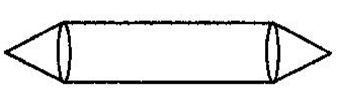
- two cones and a cylinder
- 1350
Explanation: Volume of cuboid =
Volume of cuboid =
= 1350 cu. cm
- 1350
- a hemisphere and a cone
Explanation: A plumbline is a combination of a hemisphere and a cone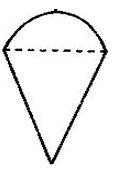
- a hemisphere and a cone
-
Explanation: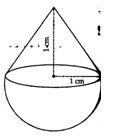
Radii of cone = r = 1 cm
Radius of hemisphere = r = 1 cm (h) = 1cm
Height of cone h =1 cm
Volume of solid = Volume of cone + Volume of a hemisphere
= =
=
= = cm3
-
- 216
Explanation: Let the radius of the smaller sphere be cm
and the radius of the bigger sphere is R cm.
Then according to question,
No. of spherical balls = =
=
= = 216
- 216
Area of equilateral triangle =
=
=
=1.732 25
=43.3 cm2Volume of the remaining solid
= Volume of the cube - Volume of the cone
= 9261 - 2425,5
= 6835.5 cm3
Hence, volume of the remaining solid is 6835.5 cm3.Let radius of the sphere = r
Ratio =
Total surface area of hemisphere : Square of radius =Diameter of the tent = 24 m
Therefore, radius = 12 m
Curved Surface area = m2Let the radius of both sphere & cone be r.
Let the height of the cone be h.
Volume of sphere =
and volume of cone =
ATQ, (given, volumes are equal)
Or, 4r = h
So, Height of cone = 4r
Diameter of sphere = 2r
diameter of sphere : height of cone = 2r : h = 2r : 4r = 1 : 2Circumference of the base = 44 m
h = 10 cm
l = m
Area of canvas required = = m2
Length of canvas required =
= 11 12.206 m = 134.27Let each equal side be a cm in length.
Then,
a = 20 cm
Hypotenuse (h) =
= a cm = 20 cm
Perimeter of the triangle = (2a + h) cm
= = 68.28 cmFor well Diameter = 7 m
Radius (r) =
Depth (h) = 20 m
Volume =
For platform Length (L) = 22 m
Breadth (B) = 14 m
Let the height of the platform be Hm.
Then, volume of the platform
According to the question,
308H =
Hence, the height of the platform is 2.5 m.- We have to find the number of spherical lead shots of diameter 4 cm can be made out of a solid cube of lead whose edge measures 44 cm.
Let n spherical shots can be made.
Solid cube is recasted into n spherical lead shots.Cube Spherical lead shots a = 44 cm r = = 2 cm
∴ Vol. of n spherical lead shots = Vol. of cube
⇒
⇒ = 44 × 44 × 44
⇒ n = = 121 × 21
⇒ n = 2541
Hence, the number of lead shots are 2541. Given the diameter = 10 m
So, the radius of the well = 5 m
Height of the well = 14 m
Width of the embankment = 5m
Therefore, radius of the embankment = 5 + 5 =10 m
Let h' be the height of the embankment,
Hence, the volume of the embankment = Volume of the well
That is, (R - r)2h' =
(102 - 52) h' = 52 14
(100 - 25) h' = 25 14
Therefore, h' = 4.67 cm approximately.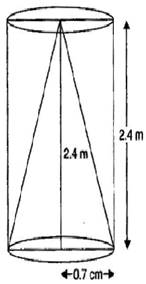
Diameter of the solid cylinder = 1.4 cm
Radius of the solid cylinder = 0.7 cm
Radius of the base of the conical cavity = 0.7 cm
Height of the solid cylinder = 2.4 cm
Height of the conical cavity = 2.4 cm
Slant height of the conical cavity = = 2.5 cm
TSA of remaining solid
= 2(0.7) (2.4) + (0.7)2 + (0.7) (2.5)
= 3.36 + 0.49 + 1.75
= 5.6
= 5.6
= 17.6 cm 2 = 18 cm 2 (to the nearest cm 2)Two cubes each of volume 64 cm3 are joined end to end. We have to find the surface area and volume of the resulting cuboid.
Let the length of each edge of the cube of volume 64 cm be x cm. Then,
Volume = 64 cm3
x3 = 64
x3 = 43
x = 4 cm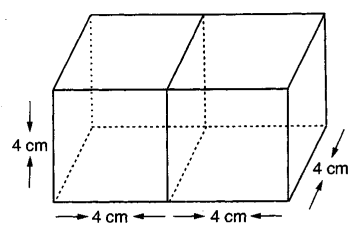
The dimensions of the cuboid so formed are:
L = Length = (4 + 4) cm = 8 cm, b = Breadth = 4 cm and, h = Height = 4 cm
Surface area of the cuboid = 2 (lb + bh + Ih)
= 2 = 160 cm2
Volume of the cuboid = Ibh = = 128 cm3We have, Radius of the circular pipe = cm
Clearly, water column forms a cylinder of radius cm. It is given that the water flows out at the rate of 72 cm/sec.
Length of the water column flowing out in one second = 72 cm.
Volume of the water flowing out per second
= Volume of the cylinder of radius cm and length 72 cm.
= 2772cm3
We know,
1 litre = 1000cm³
Now, volume of water in one hour = volume of water per second × 1hour
= 2.772 × 3600 litres [ 1 hour= 3600 sec ]
= 9979.2 litresLet us suppose that r1 cm and r2 cm denote the radii of the base of the cylinder and cone respectively. Then,
r1 = r2 = 8 cm
Let us suppose that h1 and h2 cm be the heights of the cylinder and the cone respectively. Then,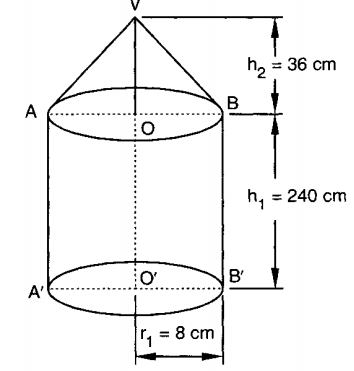
h1 = 240 cm and h2 = 36 cm
Volume of the cylinder =
Now, Volume of the cone =
Total volume of the iron = Volume of the cylinder + Volume of the cone
Total weight of the pillar =VolumeWeight per cm3
= 395366.4 gms = 395.3664 kgDiameter of the cylinder = 7 cm
Therefore radius of the cylinder =
Total height of the solid = 19 cm
Therefore, Height of the cylinder portion = 19 - 7 = 12 cm
Also, radius of hemisphere = cm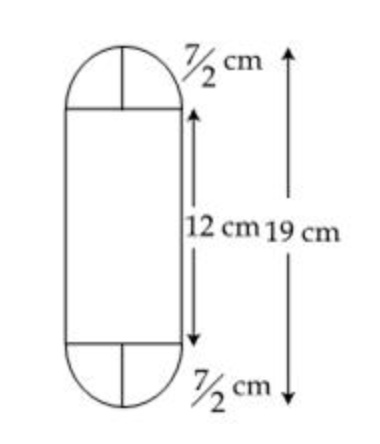
Let V be the volume and S be the surface area of the solid. Then,
V = Volume of the cylinder + Volume of two hemispheres
and,
S = Curved surface area of cylinder + Surface area of two hemispheres
= 418 cm2