Triangles - Test Papers
CBSE Test Paper 01
Chapter 6 Triangles
- In an isosceles triangle ABC if AC = BC and AB2 = 2AC2 then the measure of is (1)
- 90o
- 45o
- 60o
- 300
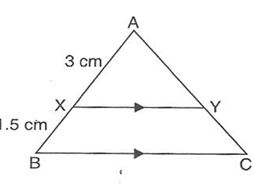
- In the given figure XY || BC. If AX = 3cm, XB = 1.5cm and BC = 6cm, then XY is equal to (1)
- 6 cm.
- 4.5 cm
- 3 cm.
- 4 cm.
- What will be the length of the hypotenuse of an isosceles right triangle whose one side is (1)
- 12 cm.
- 8 cm.
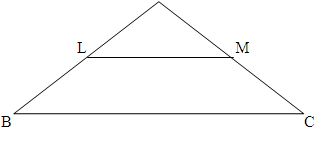
- In the given figure, if and LM||BC, Then AL:LB is equal to (1)
- 3 : 5
- 4 : 1
- 3 : 4
- 2 : 3
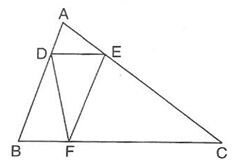
- In the follwoing figure AD : DB = 1 : 3, AE : EC = 1 : 3 and BF : FC = 1 : 4, then (1)
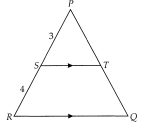
In the given figure, ST || RQ, PS = 3 cm and SR = 4 cm. Find the ratio of the area of PST to the area of PRQ. (1)
If D and E are points on the sides AB and AC respectively of such that AB = 5.6 cm, AD = 1.4 cm, AC = 7.2 cm and AE = 1.8 cm, show that DE ||BC. (1)
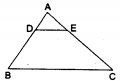
A ladder is placed in such a way that its foot is at a distance of 5 m from a wall and its tip reaches a window 12 m above the ground. Determine the length of the ladder. (1)
Triangles ABC and DEF are similar. If AC = 19 cm and DF = 8 cm, find the ratio of the area of two triangles. (1)
In the given figure, DE BC.
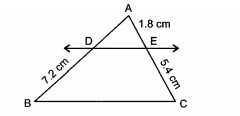
Find AD. (1)In ABC, X is any point on AC. If Y, Z, U and V are the middle points on AX, XC, AB and BC respectively, then prove that UY || VZ and UV || YZ.
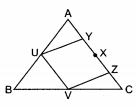
If the angles of one triangle are respectively equal to the angles of another triangle, Prove that the ratio of their corresponding sides is the same as the ratio of their corresponding angle bisectors. (2)
In a ABC, D and E are points on the sides AB and AC respectively such that DE || BC. If AD = x, DB = x-2, AE = x + 2 and EC = x - 1, find the value of x. (2)
A man goes 10m due south and then 24m due west. How far is he from the starting point? (3)
In the given figure A, B and C are points on OP, OQ and OR respectively such that AB PQ and AC PR. Prove that BC QR.
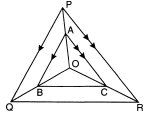
In a ABC, D and E are points on the sides AB and AC respectively such that If AD = 8x - 7, DB = 5x - 3, AE = 4x - 3 and EC = (3x -1), find the value of x. (3)
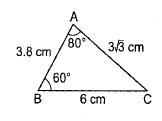
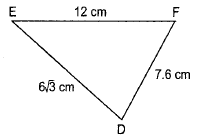
In Fig. find F. (3)
Prove that ratio of the areas of two similar triangles is equal to the square of the ratio of their corresponding sides. (4)
In a trapezium ABCD, AB | | DC and DC = 2AB. EF | | AB, where E and F lie on BC and AD respectively such that . Diagonal DB intersects EF at G. Prove that, 7EF = 11AB. (4)
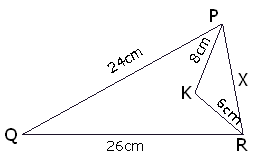
In a triangle, if the square of one side is equal to the sum of the squares on the other two sides. Prove that the angle opposite to the first side is a right angle. Use the above theorem to find the measure of PKR in the figure given below. (4)
CBSE Test Paper 01
Chapter 6 Triangles
Solution
- 90o
Explanation: Given:
[Given: AC = BC] is a right angled triangle, by converse of Pythagoras theorem
Now, since is an isosceles triangle also.
Therefore, its two sides are equal i.e., AC = BC Therefore, AB is hypotenuse.
C is a right angle i.e.,
- 90o
- 4 cm.
Explanation: Since then using Thales theorem,
XY = 4 cm
- 4 cm.
- 8 cm.
Explanation: Let AC be hypotenuse. Its equal sides are AB and BC and AB = BC = cm.Using Pythagoras Theorem,
= 32 + 32 = 64 cm2
AC = 8 cm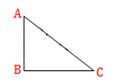
- 8 cm.
- 4 : 1
Explanation: In and [Common] [Corresponding angles as LMBC]
[AA similarity]
Now,
Let AB = 5x and AL = 4x then LB = AB - AL = 5x - 4x = 1x
AL : LB = 4 : 1
- 4 : 1
Explanation: Given: and
Therefore, in
DEBC [Using Thales Theorem]
Here we are not considering BF : FC =1 : 4.
PS = 3 cm, SR = 4 cm and ST || RQ.
PR = PS + SR
= 3 + 4 = 7 cm
In PST and PRQ
SPT RPQ (common angle)
PST PRQ (Alternate angle)
PST PRQ (AA configuration)
Hence required ratio = 9 : 49.Given: AB = 5.6 cm, AD = 1.4 cm, AC = 7.2 cm and AE = 1.8 cm
and
Hence, by the converse of Thales' theorem, .Let AC be the ladder, AB be the wall and BC be the distance of ladder from the foot of the wall.
In right ABC,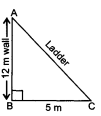
AC2 = AB2 + BC2{ using Pythagoras theorm for right-angled triangle}
AC2 = (12)2 + 52
AC2 = 144 + 25
AC = 13 mWe have,
ABC ~ DEF
AC = 19 cm and DF = 8 cm
By area of similar triangle theoremDE BC
(from BPT)
AD = 2.4 cmJoin BX
In ABX, U is midpoint of AB and Y is mid-point AX (given)
UY BX (using mid-point theorem) .....(i)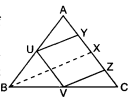
In BCX, v is mid-point of BC and z is mid-point of XC
VZ BX ..(ii)
from (i) and (ii)
UY VZ
In ABC, U is mid-point of AB and V is mid-point of BE.
UV AC
UV YZ Hence proved.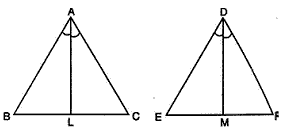
Given: Two triangles ABC and DEF in which A = D, B = E and C = F, AL and DM are angle bisectors of A
and D respectively
To prove:
Proof: Triangle ABC and DEF are Similar.
......(i)
In ABL and DEM, we have
B= E [Given]
BAL= EDM [ A= D ]
ABL DEM [AA similarity]
.......(ii)
From (i) and (ii) we haveWe have,
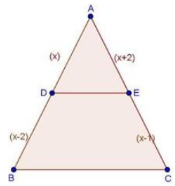
DE || BC
Therefore, by basic proportionality theorem,
We have,
x(x - 1) = (x + 2)(x - 2)
x2 - x = x2 - (2)2 [ (a - b)(a + b) = a2 - b2]
-x = -4
x = 4 cm.Starting from O, let the man goes from O to A and then A to B as shown in the figure.
Then,
OA = 10m, AB = 24m and OAB = 90o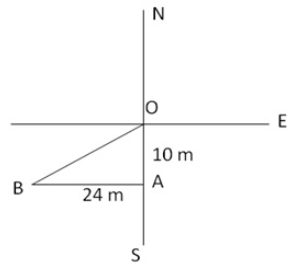
Using Pythagoras theorem:
OB2 = OA2 + AB2
OB2 = 102 + 242
OB2 = 100 + 576
OB2 = 676
OB = = 26m
Hence, the man is 26m south-west from the starting position.Proof : In ,(Given)
.......(i) (BPT)
In OPR
From eqn (I) and (ii)
HenceWe have,
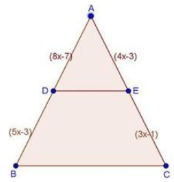
We are given that, DE || BC
Therefore, by thales theorem,
We have,
(8x - 7)(3x - 1) = (4x - 3)(5x - 3)
24x2 - 8x - 21x + 7 = 20x2 - 12x - 15x + 9
24x2 - 20x2 - 29x + 27x + 7 - 9 = 0
4x2 - 2x - 2 = 0
2[2x2 - x - 1] = 0
2x2 - x - 1 = 0
2x2 - 2x + 1x - 1 = 0
2x(x - 1) + 1(x - 1) = 0
(2x + 1)(x - 1) = 0
2x + 1 = 0 or x - 1 = 0
or x = 1
is not possible.
x = 1.In triangles ABC and DEF, we have
Therefore, by SSS-criterion of similarity, we have
A = D, B = F and C = E
D = 80°, F = 60°
Hence, F = 60°.Given :
To Prove :
Construction: Draw AD BC and PE QR
Proof :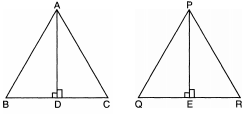
( Ratio of corresponding sides of similar triangles are equal) ...(i)
(Corresponding angles of similar triangles)......... (ii)
In
( From (ii))
[ By AA criteria]
(Corresponding sides of similar triangles) ...(iii)
From equation (i) and equation (iii)
...(iv)
()
....(v) [from eq. (iv)]
From equation (iv) and equation (v),
Ratio of the areas of two similar triangles is equal to the square of the ratio of their corresponding sides.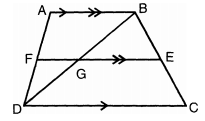
In a trapezium ABCD, AB|| DC ,. EF || AB and CD=2AB
and also -------------(1)
AB || CD and AB || EF
In
(∵ corresponding angles)
(Common)
[ By AA similarity]
...........(2)
from (1)
from equation (2),
So ......(3)
Similarly, (by AA similarity)
...(4)
Adding equations (3) and (4),we get,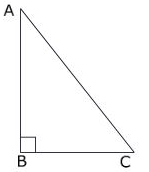
- Given: In ABC such that
AC2 = AB2 + BC2
To prove: Triangle ABC is right angled at B
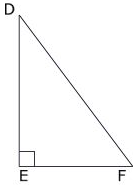
Construction: Construct a triangle DEF such that
DE = AB, EF = BC and
Proof: DEF is a right angled triangle right angled at E [construction] By Pythagoras theorem, we have
DF2 = DE2 + EF2
DF2 = AB2 + BC2 [ DE = AB and EF = BC]
DF2 = AC2[ AB2 + BC2 = AC2]
DF = AC
Thus,in ABC and DEF, we have
AB = DE
BC = EF
and AC = DF [By Construction and (i)]
ABC DEF (SSS)
B = E = 90o
Hence, ABC is a right triangle. - In QPR , QPR = 90o
242 + x2 = 262
x = 10
PR = 10 cm
Now in PKR, PR2 = PK2 + KR2[as 102 = 82 + 62]
PKR is right angled at K
PKR =90o
- Given: In ABC such that